TBF #2 - Our first Playtest
A new blog name!
Welcome back! We knew you would come back… right? I hope you had a fantastic Easter with your family, ready to start the week fresh and energized
If you missed our first entry you can read all about it right here. You can learn more about the game we are working on: Make A Pair. It should release this year!
Before we dive into the meat and potatoes of this week, you may have noticed that we now have a nice, brand new, not-trademarked, and not-protected name for our blog: TBF. It stands for Tuesday Blog Facts, but also To Be Frank (or To Believe Firmly? Who knows).
It’s directly inspired by the legendary blog post Friday Facts Factorio (or FFF). If you’ve never read it, you should definitely check it out after you finish ours!
I think this is a great motivation and goal for us: trying to get as close as possible to the consistency of FFF, but twisted with our own sauce. I think TBF is short, nice, and sweet. If you want to contest it, join our Discord and fight me over it (with kind words, please).
With that out of the way, let’s discuss playtesting!
Playtest
This week has mostly been about playtests. We were pleasantly surprised by the feedback we received on the game. For this very first round, it was mostly friends and family members, which are not as impartial as random internet strangers, but it’s already a great start after only two weeks of development. For reference, our previous game took more than six months to be “playtestable”!
Overall, here are the key elements of feedback we received.
The Shark has been a smash hit with our playtesters. They liked the idea and the fact that the Shark moves. Once you found its pair, you could easily match it. Its effect is super simple to understand, and it is the first card presented to the player after the initial deck.
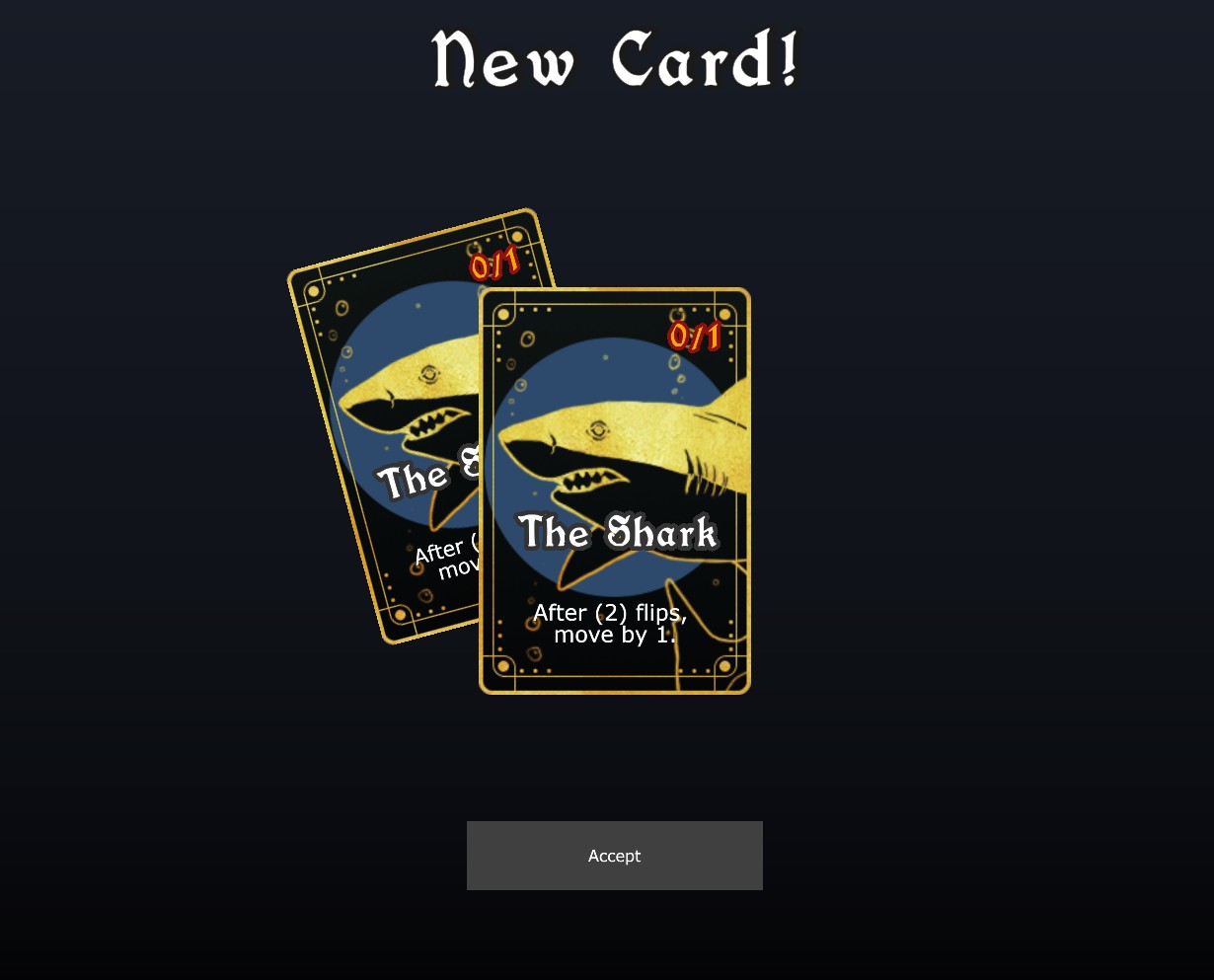
While the Shark was well received, some cards were impossible to understand, even after rewriting the card text three times! The Oracle and The Tower were incredibly hard to grasp. Only once their effects kicked in did the players fully understood what they did.
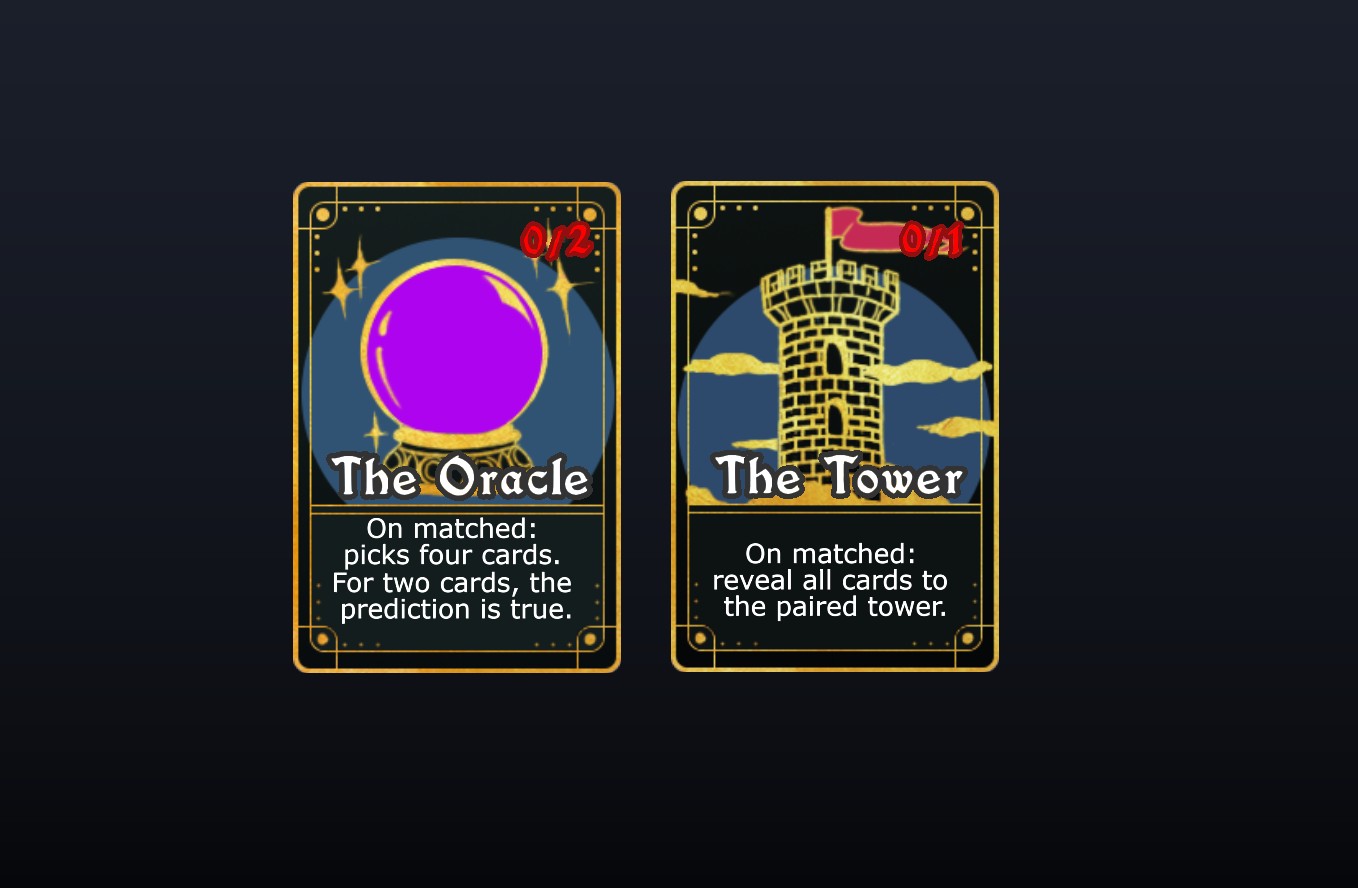 I’m 99% sure that you don’t totally understand what these cards actually do.
I will definitely rework these two cards before the next round of playtesting, which is scheduled for…the end of this week! Oof. So much work to do.
One of the main pieces of feedback was the need for an incentive to keep playing. Once a single run was completed, there was no reason to play again, as the same set of cards was dealt in the same order every time. Do not fret however; this was done solely for the purpose of the playtest.
We managed to confirm two things:
- The game is fun and it works. Since it is based on a well‑known game and each new addition was introduced one by one, it did not need an expolcit tutorial (even though there is one. More on that in a future blog post!).
- Players can tolerate different levels of cognitive load, and it’s our job to reduce that cognitive load as much as possible.
The short-term memory problem
What we saw is that using short memory is something that requires intense concentration. It’s hard to request someone to be intensely focused after a hard day of work at their job. Or if they are tired. Or doing something else.
So, relying on short-term memory requires intense concentration. It’s difficult to ask of someone to be fully focused after a hard day at work. Or when they’re tired... Or if they are doing something else… Hey, are you on your phone right now? Anyway…
It’s a limiting factor. The more there is to remember, the harder the game becomes. Once the game goes above 20 cards on the board, winning feels nearly mission impossible. We want to go far beyond 20 cards on the board and still allow you to win.
This is why we plan to add more elements that rely on long-term memory and deduction skills instead of pure short-term memory. Think about it: how is it that some games make you remember hundreds of skills, names, and elements, while others struggle to do so?
You probably know by heart the first 150 Pokémon, or hundreds of cards from Magic: The Gathering.
They are using your long-term memory with these three core concepts:
- Familiarity: Elements are built from concept you already know. For example, an animal with its fur or tail on fire probably deals… fire damage. A big, strong character in heavy armor is probably a tank. This helps you immediately categorize what things do.
- Repetition: exposure to a concept multiple times, in different context, helps you memorize the concept. The Zelda series is a great example where a mechanic is reintroduced multiple time. In Pokémon, by the time you meet wild Pikachu for the 10th time, you already know its moves.
- Uniqueness: Each element should be distinct. Without uniqueness, it becomes impossible to differentiate between concepts.
These tree elements are what we will try to bring to the game as we continue to develop it. This will greatly help reduce the mental load for the player during a game.
We will still keep a good amount of short memory element to congratulate players that want to go the extra mile, but it should be measured and balanced. Once we will reach 100 cards on the board, it might be hard to remember all the card you have ever flipped in that game.
Next week, I will present some new cards that apply these ideas like The Flintlock. Don’t miss it!
Extra bonus
As a final bonus, it seems I traumatized some playtesters’ ears with my recordings for some SFX for the game. It felt fair and just to also traumatize your ears as well.
Here is the sound effects when you do a combo with The Boat, The Trickster and The Travelers.
Is it really that bad? I’m sorry for the trauma if that’s the case.Join us!
If you want to help us, we’ll be expanding playtests to more people each round. You can join our Discord if you’d like to participate!